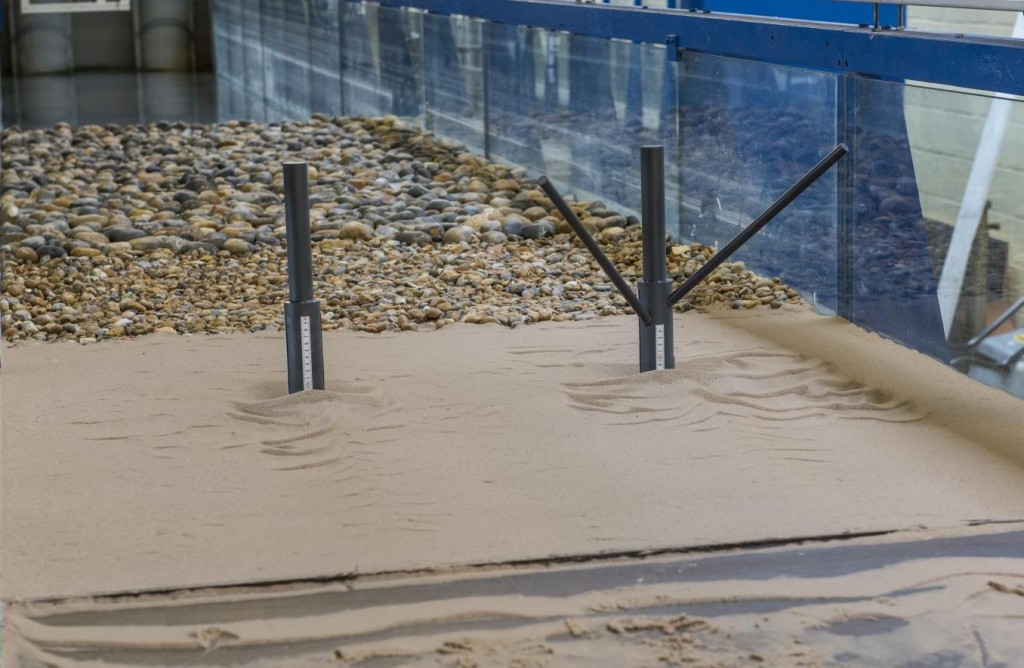
Scour is a phenomenon that occurs due to the erosive action of flowing water around structures in rivers or offshore environments. The presence of a structure results in changes to the flow conditions that lead to sediment transport and a subsequent hole around the structure. This can lead to destabilisation, as it effectively increases the length of the overall structure above the sea bed.
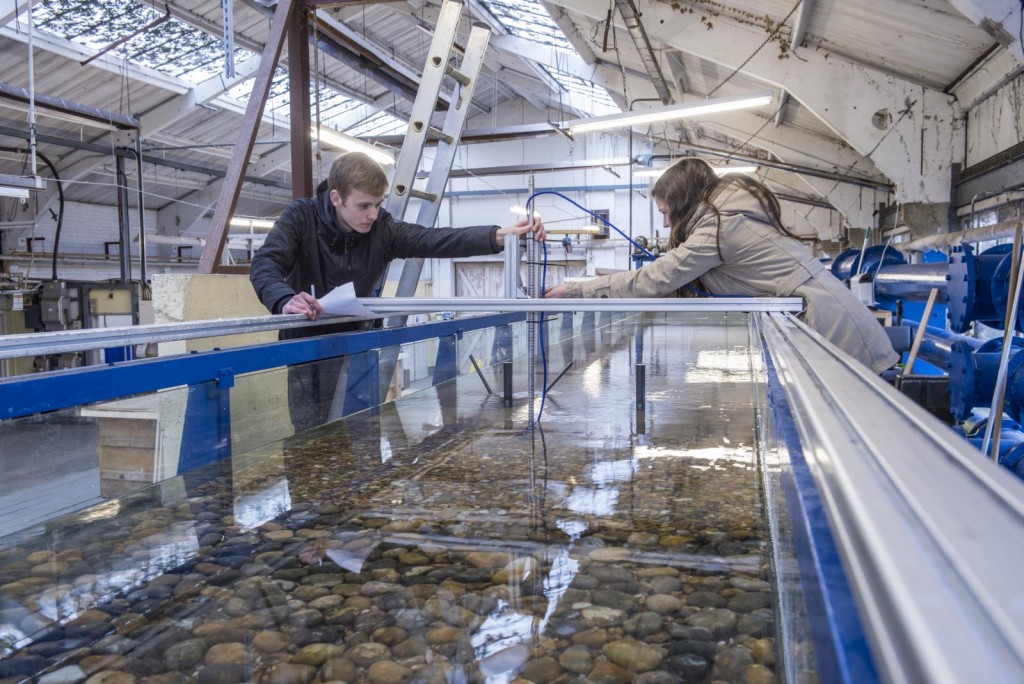
The aim of the project was to investigate the severity of scour holes and provide foundation design recommendations for the jacket foundation structures to be used by Scottish Power Renewables (SPR) at the offshore wind farm East Anglia ONE. This was achieved by designing and executing a programme of experiments conducted during a one month period in a 30 metre indoor flume at the University’s laboratory in Chilworth Manor Science Park.
A review of the information provided by SPR and general theory on scour allowed the group to design the experiments so they were relevant to the specific case the group was tasked with. Once a general plan for the experiments was made the specifics of the experiments had to be decided on, such as the scale of the models to be investigated. The group was in control of a constrained budget and so had to plan the entire project before beginning the purchase and sourcing of materials.
The experiments investigated the effects of bracing members on scour, the orientation of the models and the pile stick-up (the distance between the bed and bracing members). During each experiment the scour hole depth around the two models was measured for 15 hours. The decision was taken to model a single leg of the four-legged jacket foundation structure, which effectively doubled the number of experiments that could be conducted. Two models were specially fabricated, one with bracing members and one without in order to investigate the effects on scour.
The key results from the experiments are: It was found that the scour at the front of the braced model was 10% and 11% higher than that observed for the unbraced model, possibly due to the impacts of the bracing members on local flow velocity and vortices; the orientation of the braced model was found to have a minimal impact on the depth of scour; the pile stick-up potentially had an effect on scour depth, with lower bracing members possibly reducing the level of scour.
The aim of the project was to investigate the severity of scour holes and provide foundation design recommendations for the jacket foundation structures to be used by Scottish Power Renewables (SPR) at the offshore wind farm East Anglia ONE. This was achieved by designing and executing a programme of experiments conducted during a one month period in a 30 metre indoor flume at the University’s laboratory in Chilworth Manor Science Park.
A review of the information provided by SPR and general theory on scour allowed the group to design the experiments so they were relevant to the specific case the group was tasked with. Once a general plan for the experiments was made the specifics of the experiments had to be decided on, such as the scale of the models to be investigated. The group was in control of a constrained budget and so had to plan the entire project before beginning the purchase and sourcing of materials.
The experiments investigated the effects of bracing members on scour, the orientation of the models and the pile stick-up (the distance between the bed and bracing members). During each experiment the scour hole depth around the two models was measured for 15 hours. The decision was taken to model a single leg of the four-legged jacket foundation structure, which effectively doubled the number of experiments that could be conducted. Two models were specially fabricated, one with bracing members and one without in order to investigate the effects on scour.
The key results from the experiments are: It was found that the scour at the front of the braced model was 10% and 11% higher than that observed for the unbraced model, possibly due to the impacts of the bracing members on local flow velocity and vortices; the orientation of the braced model was found to have a minimal impact on the depth of scour; the pile stick-up potentially had an effect on scour depth, with lower bracing members possibly reducing the level of scour.