The emerging market of rehabilitation robots, including exoskeleton robotics, was valued in 2014 at $43M and is expected to rapidly increase to $1.8 Billion by 2020. Lower limb exoskeleton devices and robots are particularly useful for supporting people with e.g. weakened lower limb muscle function and mobility impairment due to ageing or illness. For instance, it is forecasted that the number of elderly people in the UK will be almost doubled by 2050. While one-in-six of the UK population is currently aged 65 and over, by 2050 one in-four will be. Being able to provide powered lower limb assistance and support to these people would help to facilitate mobility and establish independence, as well as reduce overall care costs, potentially improving millions of lives.
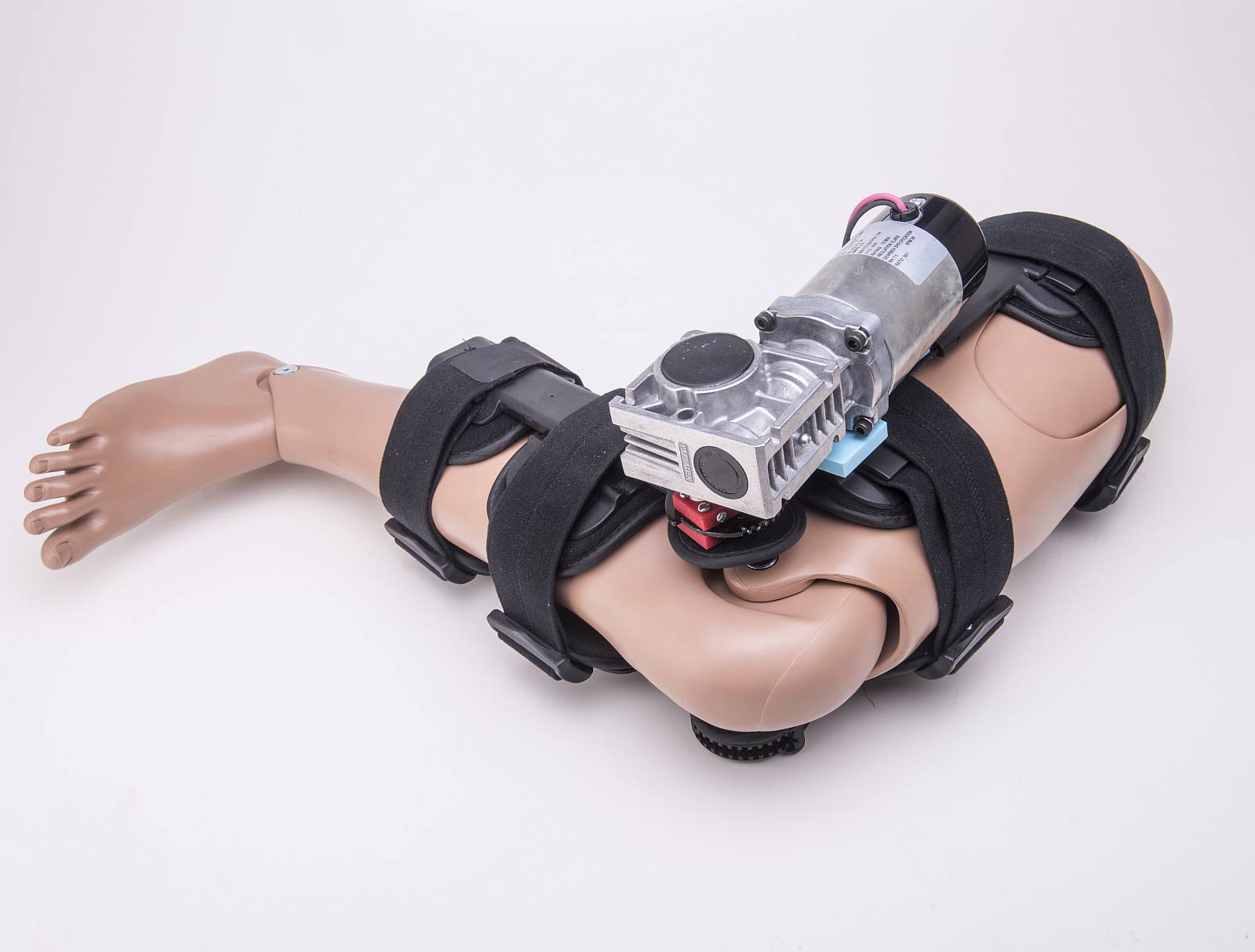
While existing lower limb robotic devices are very costly and mainly applied in high end market, this project focuses on the design, implementation and tests of a powered knee brace with relatively low cost. Gait analysis experiments were performed to determine the walking algorithm of a healthy individual. The dynamic algorithm was input to Arduinos to provide a control scheme.
The output from the Arduinos leads to the actuation of a brushed DC motor which provides power to assist walking. The functionality of the powered knee brace was successfully demonstrated on a real-size manikin. Up to 37.5% full torque needed for walking cycles was produced from the designed brace.
While existing lower limb robotic devices are very costly and mainly applied in high end market, this project focuses on the design, implementation and tests of a powered knee brace with relatively low cost. Gait analysis experiments were performed to determine the walking algorithm of a healthy individual. The dynamic algorithm was input to Arduinos to provide a control scheme.
The output from the Arduinos leads to the actuation of a brushed DC motor which provides power to assist walking. The functionality of the powered knee brace was successfully demonstrated on a real-size manikin. Up to 37.5% full torque needed for walking cycles was produced from the designed brace.