
It has been demonstrated that simply unwrapping domestic sticky tape in a vacuum chamber can produce sufficient X-rays to image a human finger via a process known as triboluminescence. If such an X-ray source could be setup to run in a stable, collimated manner, it is conceivable that a functioning small-scale computed axial tomography machine could be built from non-specialised engineering components.
With a view to producing an innovative centrepiece for schools outreach, this project considers the feasibility of the sticky-tape X-ray source and the extent to which it may be made from non-specialised parts, with due consideration of performance and safety.
In order to replicate experiments to observe the triboluminescent effect a custom vacuum chamber was built which allows maximum visibility for demonstration purposes and an easily customisable Lego tape dispenser powered by servo motors and Arduino Uno board was used. In order to detect X-rays a Giger Müller counter was placed outside the vacuum chamber and a ZnS chemical scintillation screen within the chamber allowed the production of standard X-ray contrast images. All of these elements allow the showcasing of numerous disciplines for outreach purposes ranging across structural design, computer coding, chemical processes and image reconstruction.
Initial tests showed that a far greater range of processes were occurring than originally thought, with visible light, X-ray emissions and charged particle plasmas all readily observable. The presence of charged particles is particularly detrimental to X-ray image production due to the sensitivity of the ZnS scintillation screens used. Efforts to isolate the cause and effect of each phenomenon using magnetic fields and aluminium foil filters enabled the ability to build up an understanding of each of the processes and finally produce bona fide X-ray contrast images.
Using contrast images and published attenuation data for known materials average X-ray energies can be estimated at approximately 5 KeV for this setup. This means a majority of the X-rays produced are relatively soft, thereby determining the object type for imaging (e.g. small polymer samples), with future steps being identified to increase the X-ray flux from triboluminescent sources which should enable the possibility of producing a fully 3D CAT scanner in the future.
With a view to producing an innovative centrepiece for schools outreach, this project considers the feasibility of the sticky-tape X-ray source and the extent to which it may be made from non-specialised parts, with due consideration of performance and safety.
In order to replicate experiments to observe the triboluminescent effect a custom vacuum chamber was built which allows maximum visibility for demonstration purposes and an easily customisable Lego tape dispenser powered by servo motors and Arduino Uno board was used. In order to detect X-rays a Giger Müller counter was placed outside the vacuum chamber and a ZnS chemical scintillation screen within the chamber allowed the production of standard X-ray contrast images. All of these elements allow the showcasing of numerous disciplines for outreach purposes ranging across structural design, computer coding, chemical processes and image reconstruction.
Initial tests showed that a far greater range of processes were occurring than originally thought, with visible light, X-ray emissions and charged particle plasmas all readily observable. The presence of charged particles is particularly detrimental to X-ray image production due to the sensitivity of the ZnS scintillation screens used. Efforts to isolate the cause and effect of each phenomenon using magnetic fields and aluminium foil filters enabled the ability to build up an understanding of each of the processes and finally produce bona fide X-ray contrast images.
Using contrast images and published attenuation data for known materials average X-ray energies can be estimated at approximately 5 KeV for this setup. This means a majority of the X-rays produced are relatively soft, thereby determining the object type for imaging (e.g. small polymer samples), with future steps being identified to increase the X-ray flux from triboluminescent sources which should enable the possibility of producing a fully 3D CAT scanner in the future.
-
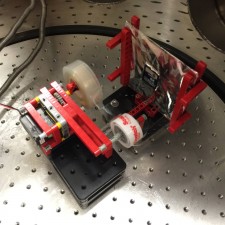
- Tape dispenser and phosphor screen setup within the vacuum chamber

-

- Tape dispenser and phosphor screen setup within professional vacuum chamber for final testing of X-ray production in pressures below that which could be achieved in our vacuum chamber

-

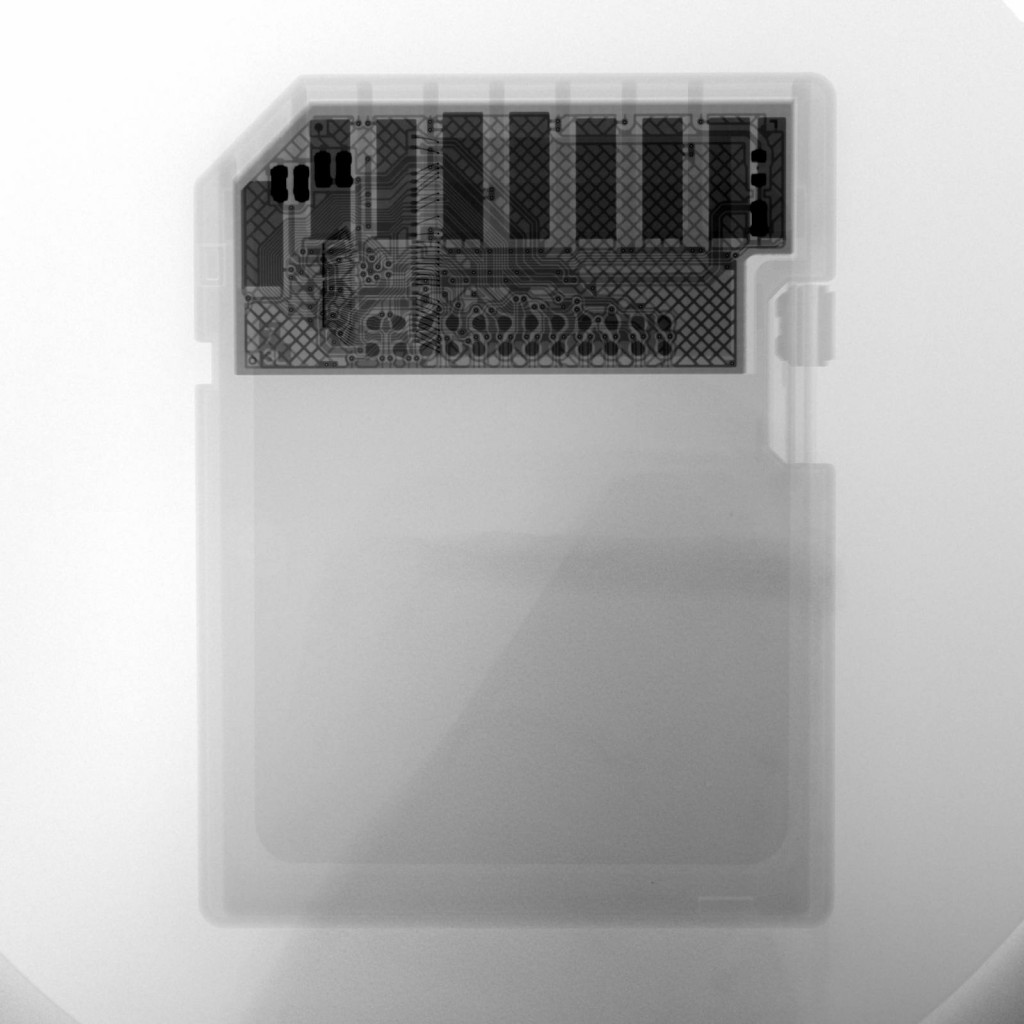
- X-ray of SD card produced in a micro-CT scanner which is based in the -VIS lab at Southampton University
-

- X-ray image of SD card capture produced by the scintillations on the phosphor screen

-

- Tape dispenser and phosphor screen setup within the vacuum chamber

