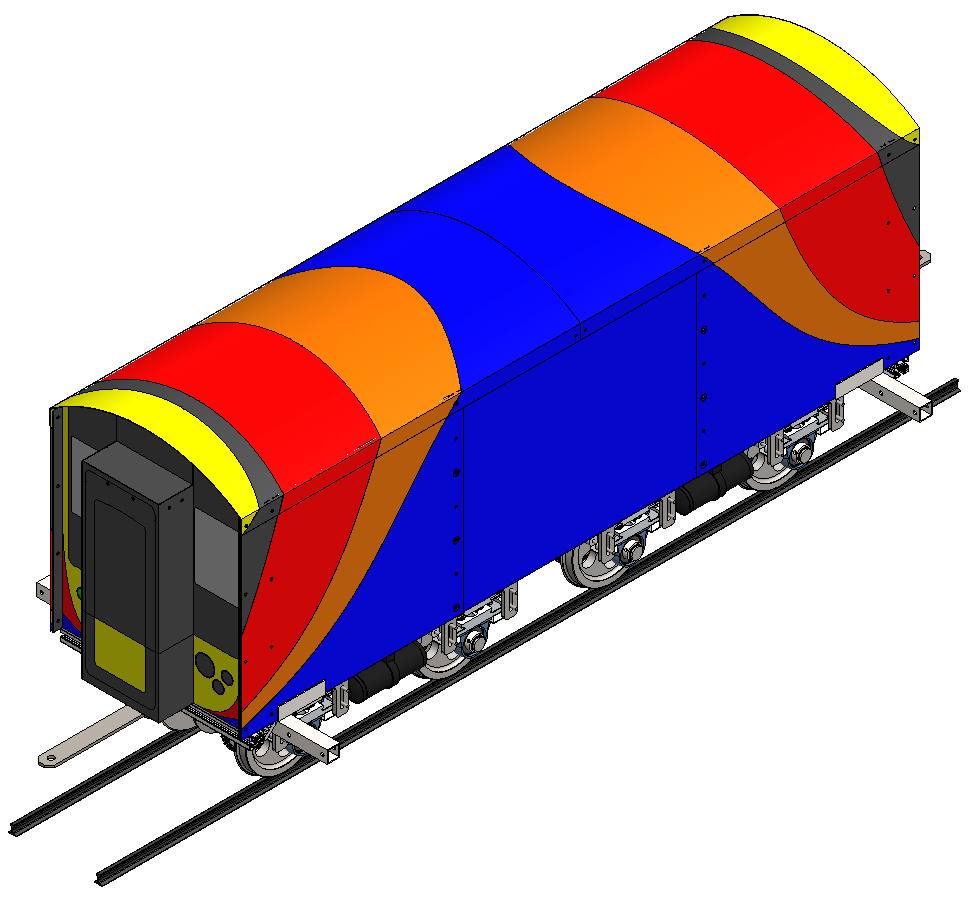
The overall aim of this project was to design and manufacture a miniature railway locomotive for entry into the IMechE Railway Challenge competition in June 2015. In doing so, the locomotive would have to be designed to adhere to a number of challenging technical specifications as set by the IMechE, such as a failsafe braking system. Although this has been the first project of its kind to run as a GDP, the project will rerun next year allowing the team to optimise the locomotive.
For the 12 man GDP team to design the entire locomotive in six months, a significant team effort was required. The team was broken down into subsystems, with the whole team meeting for two hours each week. During this time, subteam progress against an overall project plan was assessed and achievements for the week, as well as objectives for the following week, discussed. Initial research was undertaken before a complete CAD model was generated. During these stages, optimisation processes using Python & Excel, modelling such as Finite Element Analysis, experimental data and even market research all fed into the final design. Manufacture and assembly then began in February with the first successful locomotive test in late March.
One of the most innovative parts of the project is the ability of the locomotive to harvest energy which would otherwise be lost in the braking process. Running the two DC Lynch motors in reverse means that as the locomotive is slowed, electrical energy is generated and stored in a supercapacitor. This energy can then be used to drive the locomotive at a later time. Another innovative aspect of the locomotive is that it is completely remote controlled using an NI (National Instruments) myRIO microcontroller. This acts as a Wi-Fi hotspot, allowing a tablet to connect to it. Using NI’s Dashboard, the myRIO and so locomotive can be controlled via the Wi-Fi interface.
The main impact the project has had is in being the first time Southampton University has entered the IMechE Railway Challenge. As well as gaining sponsorship from Siemens, the team have received a grant from the IMechE with an accompanying press release. The team hope and expect the project to become a recurring GDP choice like that of the Formula Student project.
For the 12 man GDP team to design the entire locomotive in six months, a significant team effort was required. The team was broken down into subsystems, with the whole team meeting for two hours each week. During this time, subteam progress against an overall project plan was assessed and achievements for the week, as well as objectives for the following week, discussed. Initial research was undertaken before a complete CAD model was generated. During these stages, optimisation processes using Python & Excel, modelling such as Finite Element Analysis, experimental data and even market research all fed into the final design. Manufacture and assembly then began in February with the first successful locomotive test in late March.
One of the most innovative parts of the project is the ability of the locomotive to harvest energy which would otherwise be lost in the braking process. Running the two DC Lynch motors in reverse means that as the locomotive is slowed, electrical energy is generated and stored in a supercapacitor. This energy can then be used to drive the locomotive at a later time. Another innovative aspect of the locomotive is that it is completely remote controlled using an NI (National Instruments) myRIO microcontroller. This acts as a Wi-Fi hotspot, allowing a tablet to connect to it. Using NI’s Dashboard, the myRIO and so locomotive can be controlled via the Wi-Fi interface.
The main impact the project has had is in being the first time Southampton University has entered the IMechE Railway Challenge. As well as gaining sponsorship from Siemens, the team have received a grant from the IMechE with an accompanying press release. The team hope and expect the project to become a recurring GDP choice like that of the Formula Student project.