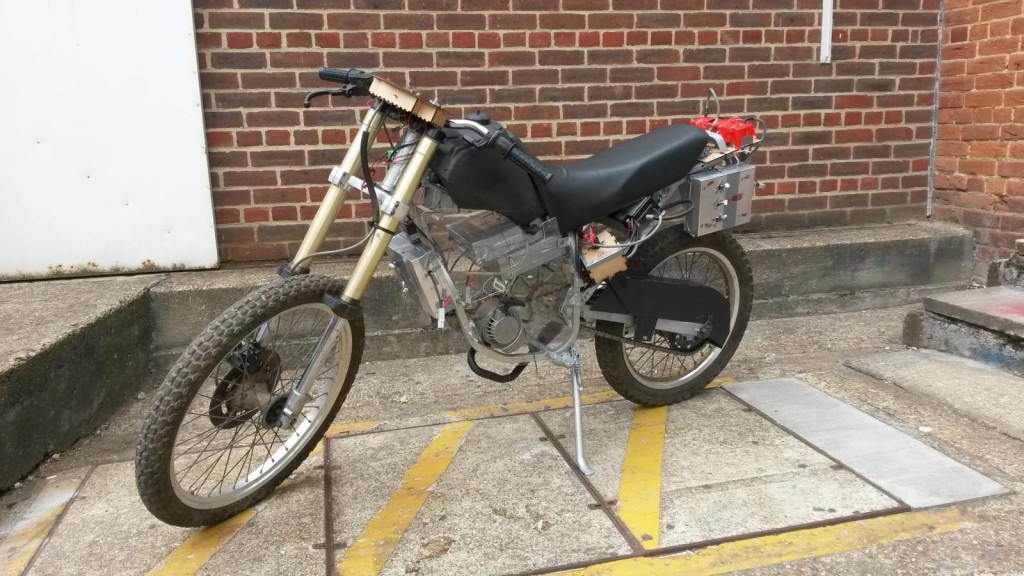
The benefits of hybrid systems are well understood from both an economical and environmental perspective. Development of hybridised and range extended electric vehicles is being undertaken by vehicle manufacturers across the globe. However, the focus of this development is mainly on applications in automobiles rather than motorcycles which are more widely used in some of the most populous parts of the world. This project focused on investigating the feasibility, development and production of a small, range extended electric motorbike. The student group had to understand and tackle the unique challenges associated with the design and integration of electric powertrains and range extender technologies.
Our project utilised background research to understand and compare the different range extender options available and their operating characteristics. These options included the use of conventional internal combustion engines, gas turbines and different types of fuel cells. A program was developed to simulate the performance of purely electric and different range extended powertrain systems. Finally, a prototype of a range extended electric motorcycle using an internal combustion engine was built to prove the feasibility of such a system.
There is currently a clear lack of research and development in the field of compact hybrid powertrain systems. The successes of this project show that it is a worthwhile avenue of research to be continued in the future. Though hybridisation in and of itself is not new, miniaturising the system is uncharted territory for the industry, and has potential for a broader field of applications.
Not only has this project sparked university interest to take it on for future projects, it has also opened an avenue of research into small hybrid systems. The proof-of-concept prototype built shows that such a system can be integrated into small vehicles and, with further funding and support, the fully working system could be shown to be viable. In addition, small hybrid systems have potential applications outside of the automotive industry. For example, they could be used to provide mechanical power in areas that do not have access to reliable sources of electrical power or fuel and where large generator
Our project utilised background research to understand and compare the different range extender options available and their operating characteristics. These options included the use of conventional internal combustion engines, gas turbines and different types of fuel cells. A program was developed to simulate the performance of purely electric and different range extended powertrain systems. Finally, a prototype of a range extended electric motorcycle using an internal combustion engine was built to prove the feasibility of such a system.
There is currently a clear lack of research and development in the field of compact hybrid powertrain systems. The successes of this project show that it is a worthwhile avenue of research to be continued in the future. Though hybridisation in and of itself is not new, miniaturising the system is uncharted territory for the industry, and has potential for a broader field of applications.
Not only has this project sparked university interest to take it on for future projects, it has also opened an avenue of research into small hybrid systems. The proof-of-concept prototype built shows that such a system can be integrated into small vehicles and, with further funding and support, the fully working system could be shown to be viable. In addition, small hybrid systems have potential applications outside of the automotive industry. For example, they could be used to provide mechanical power in areas that do not have access to reliable sources of electrical power or fuel and where large generator