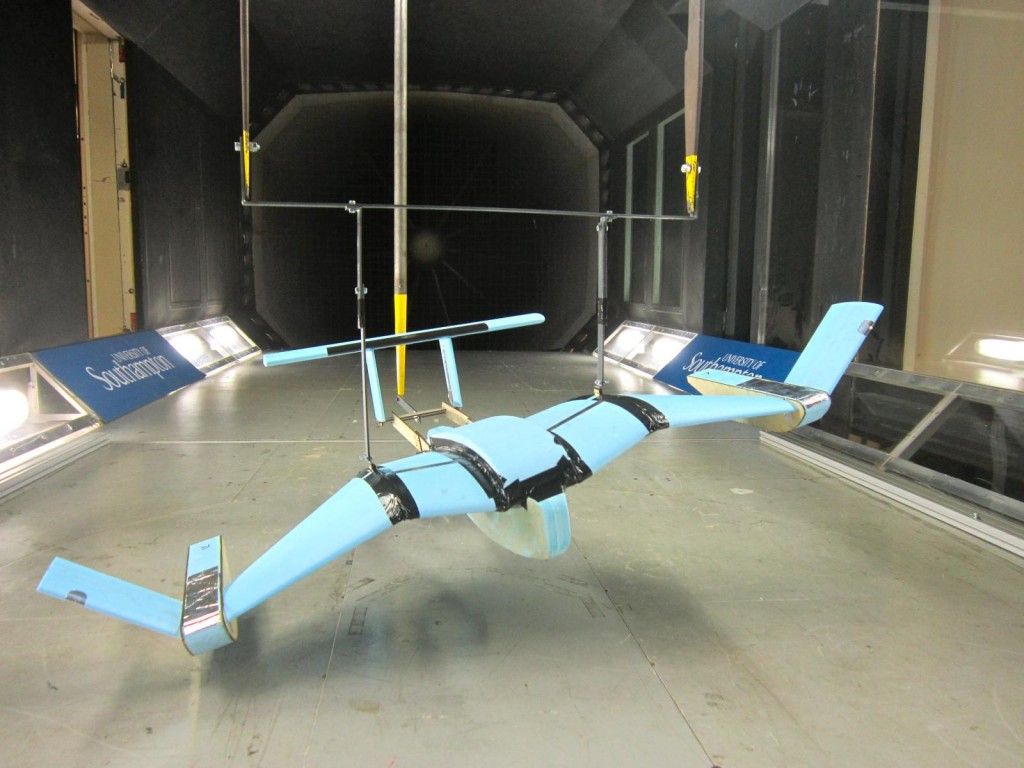
The focus of this project was to design, build and test a small amphibious wing in ground effect (WIGE) vehicle capable of stable flight within ground effect. As a means of transportation WIGE vehicles are well positioned in the niche between ships and conventional aircraft. However, before they can be fully commercialised, issues with regards to vehicle stability and propulsive efficiency need to be addressed.
Following a concept design and selection stage, two concepts, deemed to have the greatest potential, were taken forward as a platform to develop upon. This consisted of a reverse delta Anhedral Wing and a unique Gull Wing design. The project was then divided into three phases. As seen in the following poster.
From experimental testing of both configurations, the Gull Wing was shown to have enhanced aerodynamic and stability performance. Once developed into a final design and tested at the end of Phase II, the vehicle produce ample lift to satisfy take-off requirements with minimal drag. When dynamic stability was examined the vehicle exhibited inherent stability in both roll and yaw. Limitations with the dynamic rig meant pitch stability was assessed via static rig data which gave favourable results. However, during flight tests it was discovered that assumptions related to the distribution of lift between the main wing and horizontal stabiliser had resulted in the incorrect positioning of the centre of gravity. Modifications made to account for this allowed the vehicle to take-off and land safely, fly stably both in and out of ground effect and perform basic manoeuvres.
Work conducted in this project emphasised the importance of correctly determining the lift contribution of both main wing and horizontal stabiliser. As a recommendation, a lift distribution with a smaller contribution from the horizontal stabiliser, more akin to conventional aircraft, should be implemented for WIGE vehicles. Additionally, the importance of determining the point about which moments are measured (virtual pivot) in the wind tunnel was highlighted.
This projected has resulted in the opportunity for the next project working on WIGE vehicles to take a focus on the comercialisation, working with a sponser company to develop a viable product.
Following a concept design and selection stage, two concepts, deemed to have the greatest potential, were taken forward as a platform to develop upon. This consisted of a reverse delta Anhedral Wing and a unique Gull Wing design. The project was then divided into three phases. As seen in the following poster.
From experimental testing of both configurations, the Gull Wing was shown to have enhanced aerodynamic and stability performance. Once developed into a final design and tested at the end of Phase II, the vehicle produce ample lift to satisfy take-off requirements with minimal drag. When dynamic stability was examined the vehicle exhibited inherent stability in both roll and yaw. Limitations with the dynamic rig meant pitch stability was assessed via static rig data which gave favourable results. However, during flight tests it was discovered that assumptions related to the distribution of lift between the main wing and horizontal stabiliser had resulted in the incorrect positioning of the centre of gravity. Modifications made to account for this allowed the vehicle to take-off and land safely, fly stably both in and out of ground effect and perform basic manoeuvres.
Work conducted in this project emphasised the importance of correctly determining the lift contribution of both main wing and horizontal stabiliser. As a recommendation, a lift distribution with a smaller contribution from the horizontal stabiliser, more akin to conventional aircraft, should be implemented for WIGE vehicles. Additionally, the importance of determining the point about which moments are measured (virtual pivot) in the wind tunnel was highlighted.
This projected has resulted in the opportunity for the next project working on WIGE vehicles to take a focus on the comercialisation, working with a sponser company to develop a viable product.