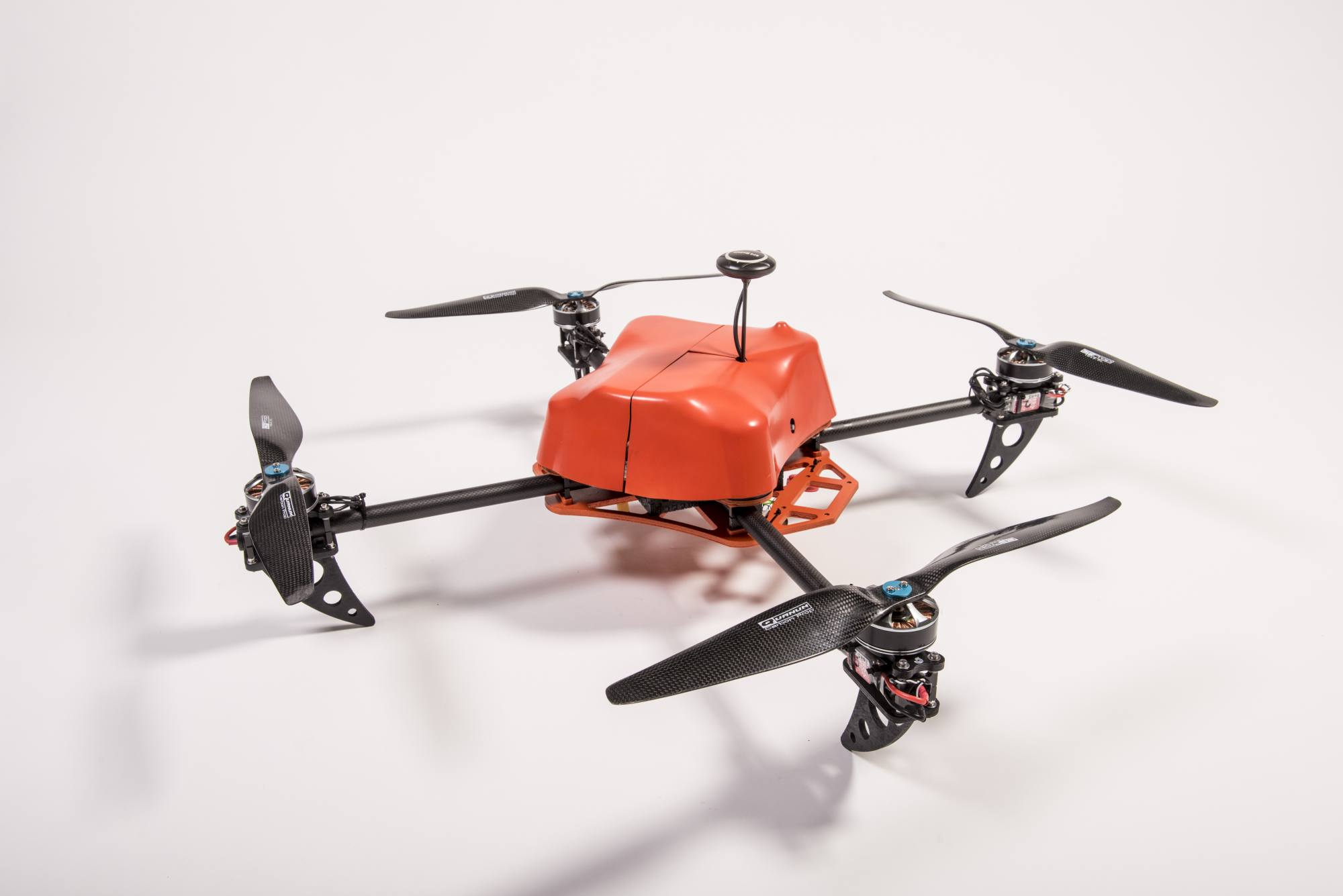
Team Daedalus is a team of 5 students from the Unmanned Aircraft Systems Design MSc who have been tasked to compete in the IMechE UAS Challenge 2016. The objective of the UAS Challenge is to design and manufacture a system which can deliver 2 kg of payload in a Disaster Relief Scenario. The system must not exceed a Maximum Take-Off Mass of 7 kg and be capable of autonomously detecting the target area.
Based on the UAS Challenge rules and those requirements generated from critical analysis of real world scenarios, Team Daedalus created the following design philosophy: Modularity; Design Simplicity; Manufacturing Simplicity; Portability and Incremental Design.
This philosophy and analysis of the requirements resulted in Team Daedalus determining that a quad rotor configuration is the optimum design. To achieve this task, an incremental design and build approach was taken. Firstly, the Mk 1 system was manufactured in Semester 1 and flight testing was conducted in Semester 2. Secondly, the Mk 2 system was developed and manufactured in Semester 2, utilising lessons identified from the Mk 1 flight test programme. The Mk 2 system has since been subject to flight testing since April 2016 and this process will continue until the UAS Challenge Demonstration Event in July 2016. Separately to the airframe design, manufacture and flight test programme, the target recognition system has been developed.
The flight test programme has allowed a progressive approach to expanding the flight envelope in both manual and autonomous flight modes. The system is now capable of autonomous take-off, transit between waypoints, payload delivery and landing. It can also be flown in manual (stabilized) mode.
Material selection has been key to the success of this project. The majority of airframe components are manufactured from laser cut plywood, a material which is cheap, quick to manufacture and has very good strength characteristics. The booms are constructed of carbon fibre, which has ideal material properties for this system.
The system is ready for the UAS Challenge Demonstration Event and Team Daedalus have high expectations of success representing the University of Southampton.
Max takeoff mass 10 kg; Max Endurance 26 mins; Max Payload 5.5 kg.
Based on the UAS Challenge rules and those requirements generated from critical analysis of real world scenarios, Team Daedalus created the following design philosophy: Modularity; Design Simplicity; Manufacturing Simplicity; Portability and Incremental Design.
This philosophy and analysis of the requirements resulted in Team Daedalus determining that a quad rotor configuration is the optimum design. To achieve this task, an incremental design and build approach was taken. Firstly, the Mk 1 system was manufactured in Semester 1 and flight testing was conducted in Semester 2. Secondly, the Mk 2 system was developed and manufactured in Semester 2, utilising lessons identified from the Mk 1 flight test programme. The Mk 2 system has since been subject to flight testing since April 2016 and this process will continue until the UAS Challenge Demonstration Event in July 2016. Separately to the airframe design, manufacture and flight test programme, the target recognition system has been developed.
The flight test programme has allowed a progressive approach to expanding the flight envelope in both manual and autonomous flight modes. The system is now capable of autonomous take-off, transit between waypoints, payload delivery and landing. It can also be flown in manual (stabilized) mode.
Material selection has been key to the success of this project. The majority of airframe components are manufactured from laser cut plywood, a material which is cheap, quick to manufacture and has very good strength characteristics. The booms are constructed of carbon fibre, which has ideal material properties for this system.
The system is ready for the UAS Challenge Demonstration Event and Team Daedalus have high expectations of success representing the University of Southampton.
Max takeoff mass 10 kg; Max Endurance 26 mins; Max Payload 5.5 kg.
-

- Overall CAD render of the mark 2 system
-

- Interior construction of the airframe
-
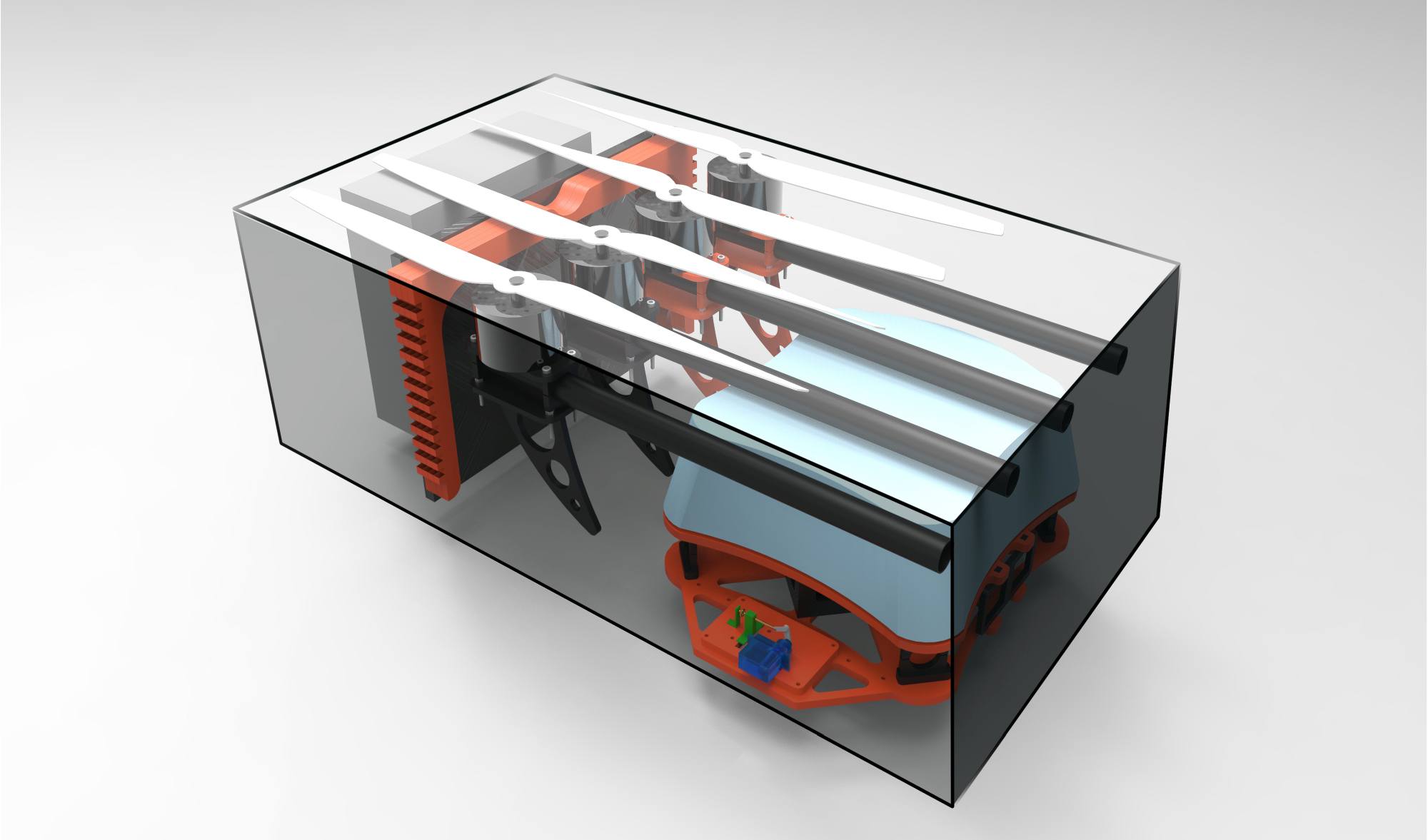
- The system packaged in the transportation box