Rescue missions put in place to assist the survivors after a natural disaster are not always able to be carried out immediately. Additionally; costs, ease of use and lower risk are huge factors, which are detrimental in these situations. These four points were the foundation for creating the solution.
In order to prove the capabilities of the UAV the IMechE UAS Challenge 2016 was entered, which brought other specific requirements such as full autonomy, alphanumeric image recognition, 7 kg maximum weight, £1000 cost limit.
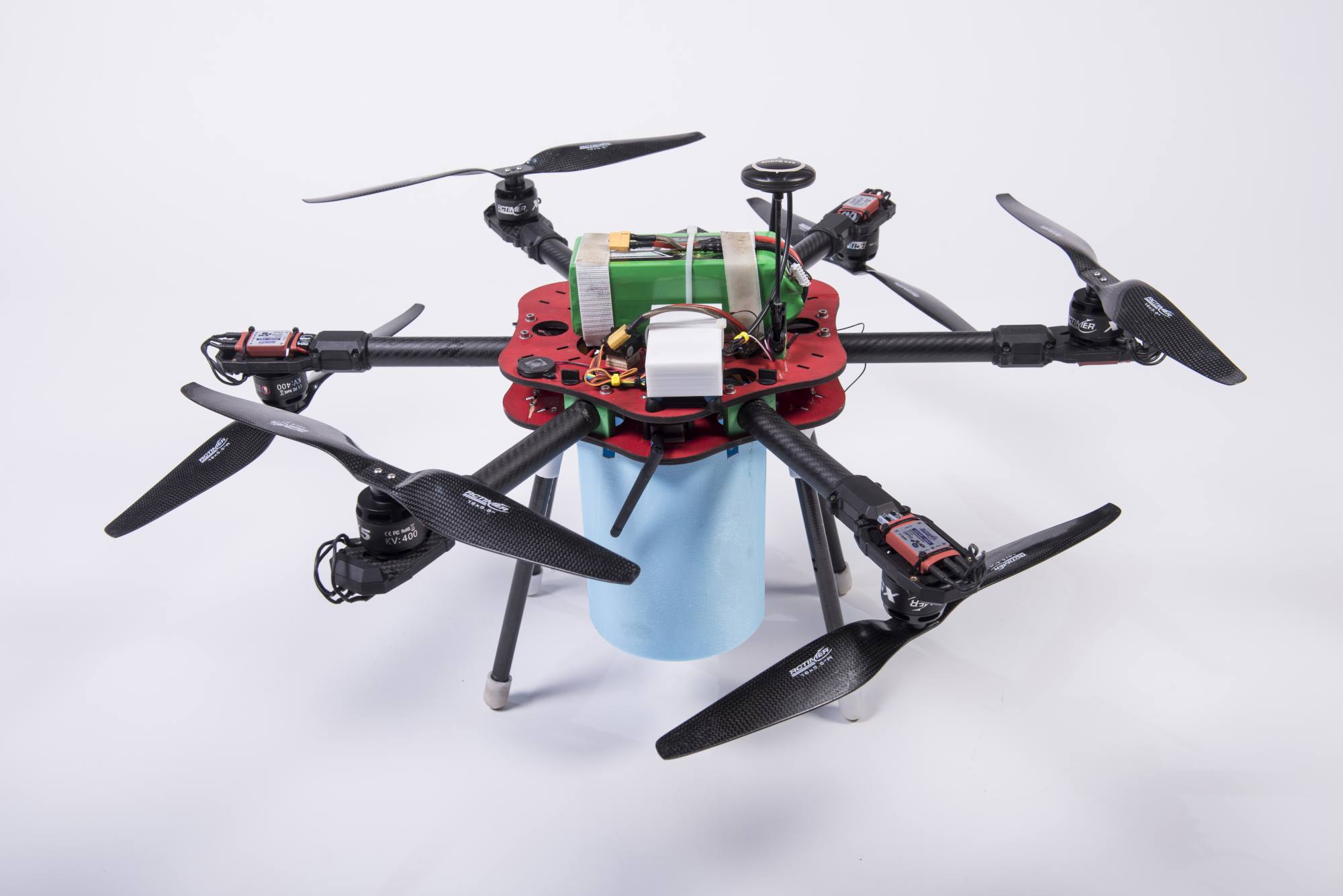
The system is a hexacopter with two arms fixed at each side with the remaining four arms able to fold towards the fixed arms, making it a linear folding system. The bottom plate is fitted with a cargo support bay, payload release mechanism, detachable landing gear and a camera for the imaging system. The top plate holds the battery, GPS module, payload servos and the flight controller. These modules have all been made weather-proof by applying epoxy on circuit boards or using 3D printed weather shields.
The centre plates are made from painted plywood while the arms and landing gear are made from carbon fibre tubes held by 3D printed ABS plastic components. On the hinge where the arms fold, there is a rubber damper fitted inside a printed part to absorb vibrations from each arm individually. The motor and flight controller mounts are commercial off-the-shelf (COTS) components but all other parts of the airframe have been designed and manufactured by the team.
One of the unique features that this system has is the overlapping propellers design. Alternating propellers has been turned upside down with approximately 10% overlap between each propellers. Although the overlap may cause problems in vibration and cavitation, the total dimension is reduced significantly by 12 cm without losing efficiency.
The system is designed for efficiency, ease of assembly and operation. Total assembly time from box to flight is less than 10 minutes including all hardware and radio safety checks as well as loading the payloads. Landing gear attaches using 5 kg magnets for each leg, and all propellers can be removed. The whole assembly process is entirely tool free.
In order to prove the capabilities of the UAV the IMechE UAS Challenge 2016 was entered, which brought other specific requirements such as full autonomy, alphanumeric image recognition, 7 kg maximum weight, £1000 cost limit.
The system is a hexacopter with two arms fixed at each side with the remaining four arms able to fold towards the fixed arms, making it a linear folding system. The bottom plate is fitted with a cargo support bay, payload release mechanism, detachable landing gear and a camera for the imaging system. The top plate holds the battery, GPS module, payload servos and the flight controller. These modules have all been made weather-proof by applying epoxy on circuit boards or using 3D printed weather shields.
The centre plates are made from painted plywood while the arms and landing gear are made from carbon fibre tubes held by 3D printed ABS plastic components. On the hinge where the arms fold, there is a rubber damper fitted inside a printed part to absorb vibrations from each arm individually. The motor and flight controller mounts are commercial off-the-shelf (COTS) components but all other parts of the airframe have been designed and manufactured by the team.
One of the unique features that this system has is the overlapping propellers design. Alternating propellers has been turned upside down with approximately 10% overlap between each propellers. Although the overlap may cause problems in vibration and cavitation, the total dimension is reduced significantly by 12 cm without losing efficiency.
The system is designed for efficiency, ease of assembly and operation. Total assembly time from box to flight is less than 10 minutes including all hardware and radio safety checks as well as loading the payloads. Landing gear attaches using 5 kg magnets for each leg, and all propellers can be removed. The whole assembly process is entirely tool free.
-
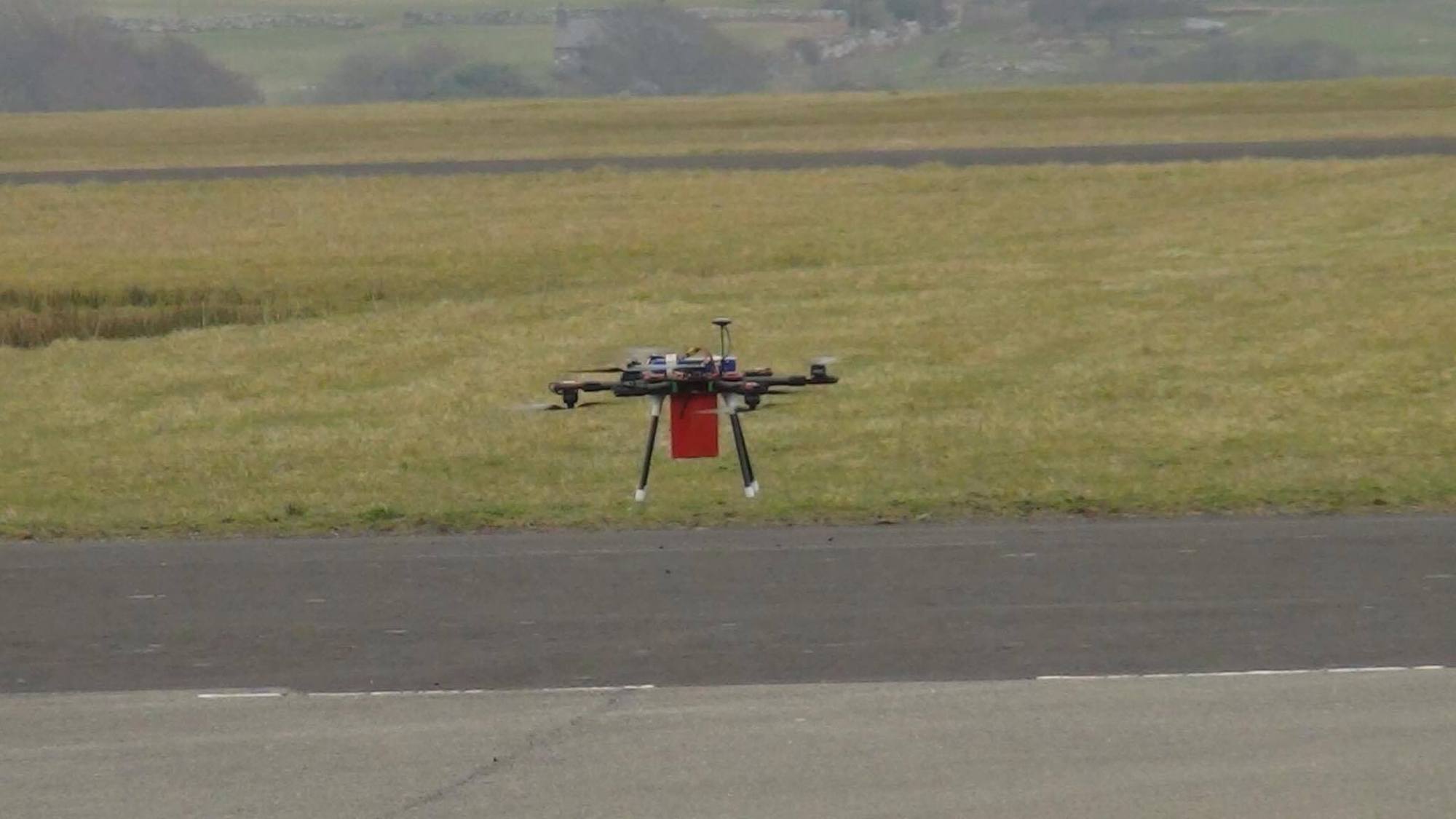
- Saffire during testing
-
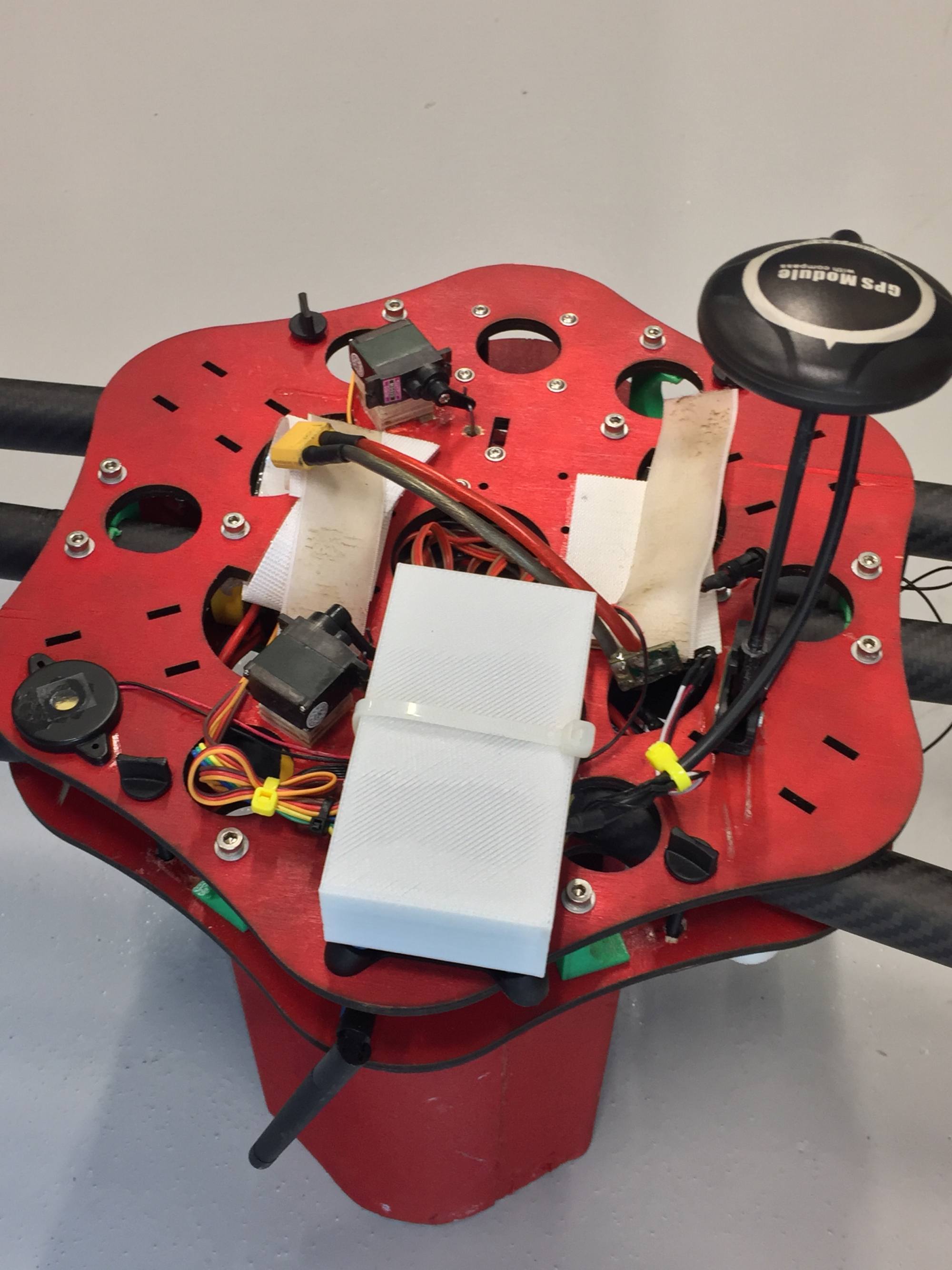
- Mark 3, showing how components are arranged. Thumb screws for foldable arms. Flight controller protected with printed weather shields and servos to release the payloads