
Spaceflight Society Design, build and test of custom rockets




Committee
Zoe Costigan
Nicholas Hall
Louis Hall
Elizabeth Paine
Ethan Wilson
Nik Pedzik
Grace Garczynski
Alexander Wolverson
Adi Soundalgekar
Filippo Caley
Veon Predeina
Team Leads
Nathan Ormerod
Garan Carter-Woodgate
Tianna Patel
Diego Paniagua Silva
Vidzaja Bartczak
Cosmo Prior
Daniel Best Tellez
Supervisor
Dr Charlie Ryan
Spaceflight Society has run seven projects this year: Electric Propulsion, Mars Rover, High-powered Rocketry, CanSat, Liquid Rocket Engine, Starworks and Turbomachinery (Project Ceres).
Project Ceres has continued developing the turbopump assembly, finalising both centrifugal pumps, impulse style turbine and regeneratively cooled pre-burner. Work is now progressing on other components such as dynamic seals and high speed bearings.
The electric propulsion team has further developed the Io2 design and remanufactured some components to improve operation. We have also started a long term project to develop a low power metal propellant hall effect thruster and hollow cathode called Zeus. This aims to be the first student undergraduate team metal propellant HET.
At Starworks, we have completed designing our new liquid rocket engine Banshee and started on test stand design to provide SUSF with a liquid engine testing capability. Our structures and hardware teams have also been finalising the design of our lander.
This year the High-Power rocketry division of the society have been working to build a two stage rocket to reach our highest altitudes yet, as well as continuing our entry to the annual Mach-X competition. CanSat has been developing this year’s Mach entry payload, using a custom SRAD PCB stack that will function as an atmospheric sensor suite.
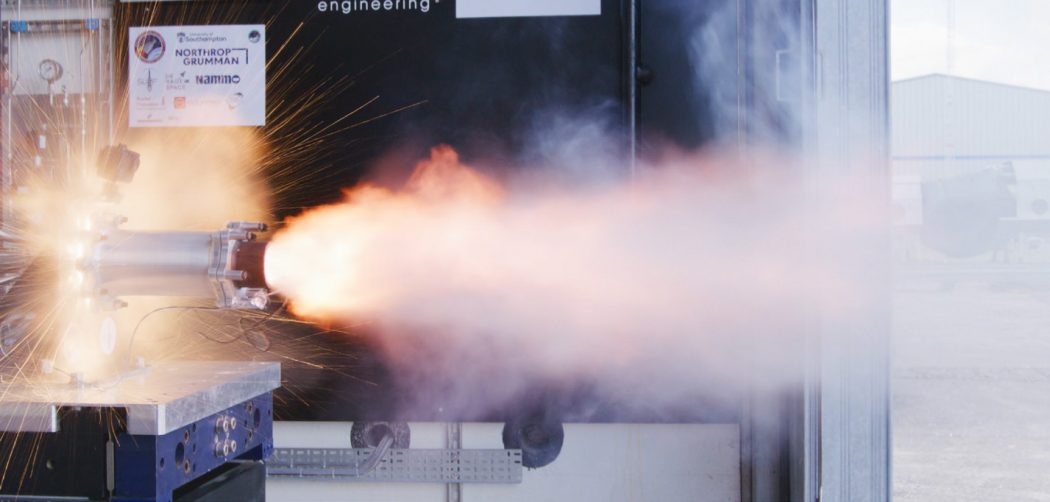
SULRE has been focusing on the continued development of their Comet 1 liquid rocket. In March, Comet 1 was successfully hot fired at Newton Launch System’s brand new test facility in Snowdonia. This test represents a major milestone towards SULRE’s objective of becoming the first UK university team to launch a SRAD liquid rocket within the UK.
Mars Rover has successfully passed its Critical Design Review (CDR), marking a major milestone in the rover’s development. The team has tested a range of electronic components and produced several prototype systems to validate key design concepts and functionality. With these stages now complete, work is progressing towards the construction and assembly of the rover itself.


